Bitter filter coffee has several possible causes, and grinding coarser is not always the answer. A dark roast may taste bitter by design; an uneven brew can taste sharp and drying at once; old oils in a carafe can make even a good recipe unpleasant. The fastest fix is to separate these possibilities before changing every setting. Use the same beans and a measured recipe while you work through the checks below.
First decide what you mean by bitter
A little bitterness is a normal part of coffee. What you may want to remove is an unpleasant burnt note, a harsh aftertaste or a drying sensation along the gums. Dryness is often described as astringency, while sharp sourness is a different sensation. These can overlap, so avoid treating every bad cup as proof of over-extraction. Let the coffee cool enough to taste comfortably and compare the beginning, middle and finish of a sip.
| What you notice | Possible cause | Useful first check |
|---|---|---|
| Smoky or burnt in every cup | Roast style | Try a lighter roast using the same recipe |
| Dry mouth and stalled draining | Grind or heavy agitation | Try coarser or fewer swirls |
| Sour and harsh together | Uneven extraction | Check wetting, clumps and grinder consistency |
| Stale, greasy or rancid note | Residue in equipment | Clean the carafe and reusable filter |
| Very intense but otherwise balanced | High concentration | Dilute a small sample before rebrewing |
Step 1: rule out dirty equipment
Smell the empty, dry carafe and brew basket. Wash removable parts according to the manufacturer instructions, paying attention to lids, mesh filters and corners where oils collect. Rinse cleaning products thoroughly. A water-only cycle does not necessarily remove oily residue, and descaling addresses mineral deposits rather than every kind of dirt. Our cleaning and descaling guide explains the difference. Do not run an improvised acid mixture through a machine that specifies a particular cleaner.
Step 2: check the roast before changing the recipe
If a clean brewer consistently makes a smoky cup from a dark-roasted bean, the roast may simply not match your preferences. Try a medium roast with chocolate or caramel notes instead of chasing a setting that eliminates all roasted flavor. A small bag is enough for a comparison. If you like darker coffee with milk, taste it that way as well: the best black-coffee recipe for someone else may not be your favorite breakfast drink. Our light versus dark roast guide helps narrow the choice.
Step 3: establish a repeatable baseline
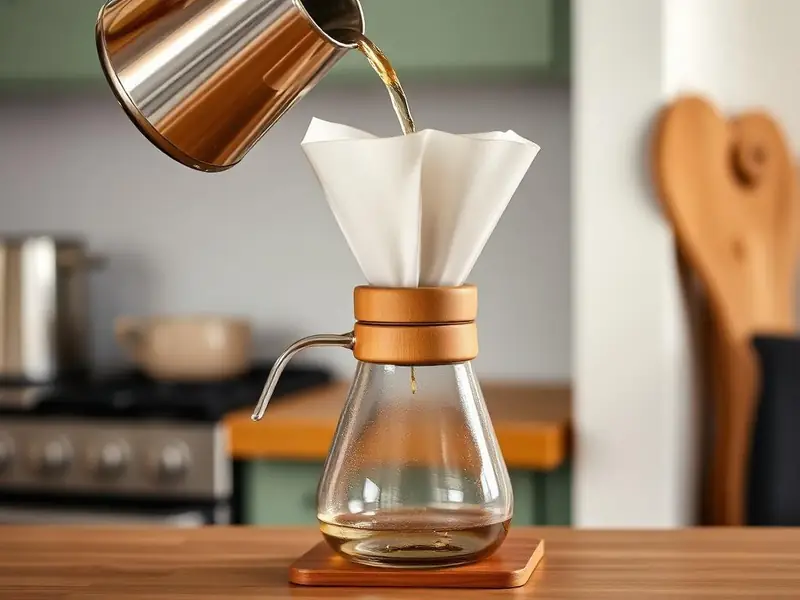
For a manual paper-filter brew, begin with 20 g coffee and 320 g total water. Use a medium grind and water around 93°C / 199°F. Wet the grounds evenly and pour steadily without excessive stirring. For a drip machine, follow its minimum batch guidance and filter instructions rather than forcing a tiny dose into a basket designed for a carafe. Note the setting and taste before making a change. The brew calculator can scale the ratio to your usual batch.
If you normally use scoops, weigh one ordinary dose to see how much coffee you are actually adding. Scoops vary with bean density and how they are filled, so a measured baseline can reveal that yesterday’s “same recipe” was not really the same. A kitchen scale is sufficient to begin; a dedicated coffee scale adds convenience and a timer, not a requirement to enjoy a good cup.
Step 4: change grind or agitation, not both
When the brew stalls and tastes drying, try a modestly coarser grind with the same dose and water. If that improves flow but the cup is still harsh, return to the previous setting and compare gentler pours with fewer swirls. These two experiments tell you more than changing grind, temperature, ratio and pour technique together. Some beans produce more fine particles than others; brew time alone cannot tell you whether the cup is extracted well.
If coffee runs quickly yet tastes both sour and bitter, look for uneven wetting or water flowing down a gap at the edge of the filter. Rinse and seat the filter properly, level the grounds and distribute the first pour across the bed. A consistent burr grinder can help, but it is worth correcting the technique before buying one. The pour-over guide shows a simple starting routine.
Step 5: separate strength from extraction
Pour a small sample of the finished coffee and add a little hot water. If the unpleasant intensity disappears while the flavor becomes balanced, concentration may be the main issue. Try less coffee for the same brew water next time, moving from 1:16 toward 1:17. If dilution merely gives you weaker burnt coffee, investigate the roast or brew instead. Dilution changes concentration; it does not undo the flavors already extracted from the grounds.
Step 6: test temperature and water
For a dark roast that still tastes harsh after the other checks, try slightly cooler water while holding the recipe steady. For a light roast, do not automatically cool the kettle: the cup may need a different grind or better wetting instead. If every bag tastes wrong, compare the brew using another water source suitable for your equipment. Filter pitchers vary in what they remove; a TDS reading alone cannot diagnose hardness, alkalinity or flavor. Start with the water guide.
Useful gear, with clear trade-offs
Baratza Encore
Pros
- Burr grinding with repeatable adjustments
- Appropriate for many filter brewing routines
Cons
- Will not remove bitterness inherent in a roast
- Not a substitute for a clean brewer
Hario V60 Drip Scale
Pros
- Weighs coffee and brew water
- Integrated timer helps record recipes
Cons
- Check dimensions for your brewer
- An existing kitchen scale may be enough
Kalita Wave 185 Stainless
Pros
- Flat-bottom paper-filter brewing
- Useful alternative for a steady pour routine
Cons
- Needs compatible Wave filters
- Technique and grind still affect flavor
BWT Magnesium Filter Pitcher
Pros
- A convenient option for comparing filtered tap water
- Replaceable cartridges
Cons
- Performance depends on incoming water
- Does not guarantee water meets a machine specification
Keep the change that actually improves the cup
Stop when the drink is enjoyable rather than when a stopwatch matches a recipe online. Write down the best setting and repeat it the following day. If the result swings wildly, focus on dose, wetting and cleaning consistency. If it remains predictably bitter, try a different roast. You can learn more from a controlled comparison between two coffees than from buying a more expensive brewer and continuing the same routine.
Compare filter-coffee gearShopBuy it now
Shop the gear in this guide
Live Amazon listings for the products mentioned above. Prices checked September 2, 2026.


Frequently asked questions
Does bitter coffee always mean over-extraction?
No. Roast style, dirty equipment, high concentration and uneven extraction can also make coffee unpleasantly bitter.
Should I grind coarser for bitter pour over?
It is a useful experiment when draining is slow and the cup feels drying. Keep dose and water unchanged to compare fairly.
Can adding water fix bitter coffee?
It can improve an overly strong cup, but it cannot remove burnt or stale flavors already present.
Tools & deeper dives
More on grinders and brewing basics.
Recommended gear
Gear used in this techniques guide
Editor-tested picks. Buying through these Amazon links keeps HomeCoffeeBrew free.
Free download
Like this guide? Get one every Sunday.
Plus our free Brew Ratio Cheat Sheet — dial-in ratios for every method, delivered instantly as a PDF.
Keep reading
More gear reviews and city guides
Product reviews
- Baratza Encore ESP · Grinder
- Baratza Encore · Grinder
- Fellow Opus · Grinder
- Eureka Mignon Specialita · Grinder
- 1Zpresso J-Max · Grinder
- 1Zpresso JX-Pro · Grinder
- Breville Bambino Plus · Espresso
- Breville Barista Pro · Espresso
- Gaggia Classic Pro · Espresso
- Rancilio Silvia Pro X · Espresso
- Hario V60 02 Ceramic · Pour-Over
- Chemex 6-Cup Classic · Pour-Over
- Kalita Wave 185 Stainless · Pour-Over
- Fellow Stagg EKG · Kettle
- Fellow Stagg [X] Pour-Over Set · Kettle
- Timemore Black Mirror Basic 2 · Scale
- Timemore Black Mirror Nano · Scale
- Hario V60 Drip Scale · Scale
- Acaia Pearl S · Scale
- AeroPress Original · Immersion
- AeroPress Go · Immersion
- Bodum Chambord 8-Cup French Press · Immersion
- Bialetti Moka Express 6-Cup · Immersion
- Bialetti Venus Stainless · Immersion
- Toddy Cold Brew System · Immersion
- Bonavita BV1900TS 8-Cup · Drip & Pod
- OXO Brew 8-Cup Coffee Maker · Drip & Pod
- OXO Brew Compact Single Serve · Drip & Pod
- Keurig K-Elite · Drip & Pod
- Nespresso Vertuo Next · Drip & Pod
- Third Wave Water Classic Profile · Water & Storage
- BWT Magnesium Filter Pitcher · Water & Storage
- HM Digital TDS-EZ Meter · Water & Storage
- Airscape Coffee Canister · Water & Storage
- Fellow Atmos Vacuum Canister · Water & Storage